Planed Lumber Versus Rough-Sawn Lumber
The primary difference between planed lumber and rough-sawn lumber is how the material is processed after it leaves the sawmill. Rough-sawn lumber is cut directly from logs and retains a relatively coarse surface texture, along with minor variations in thickness and dimensions. Planed lumber goes through an additional milling process in which rotating cutterheads remove small amounts of material to create smoother surfaces and more consistent dimensions.
Rough-sawn lumber is often used when a project calls for a more natural wood appearance or when additional machining will take place before the material is ready for use. It can also provide greater flexibility for manufacturers who want to customize dimensions, profiles, and finishes during production.
Planed lumber, on the other hand, is processed to provide a smoother, more uniform surface. This makes it easier to measure, cut, assemble, and incorporate into many residential construction projects. Planed lumber is commonly used for interior trim, cabinetry, furniture components, flooring, shelving, and other applications where consistent dimensions and surface quality are important.
Both options serve important purposes in construction and manufacturing. The right choice depends on the project's specifications, intended application, and desired finish. Working with an experienced planer mill allows builders and manufacturers to select lumber that meets their requirements, whether they need rough-sawn material for further processing or professionally planed boards ready for the next stage of production.
1. Structural Framing and Interior Wall Construction
So much of a home’s construction is made up of structural framing. Different sizes of dimensional lumber are used for structural and non-structural framing. Most of which is covered up by drywall or other finish work. However, this wood needs to be accurately sized and properly finished. Some of the major dimensional lumber sizes include:
- 2x4: Used for interior walls, non-bearing partitions, and standard wall studs.
- 2x6: Used for exterior load-bearing walls, heavy plates, and thick partitions.
- 2x8, 2x10, 2x12: Used for heavy structural applications such as floor joists, ceiling joists, and roof rafters.
Most framing lumber is sold as spruce-pine-fir, Douglas fir-larch, or southern yellow pine. This lumber is typically more affordable and does not need to be a hardwood. While some contractors may use rough-sawn framing lumber, planed wood is much more consistent and can help simplify measuring, cutting, and fitting during construction.
2. Roof Trusses, Rafters, and Ceiling Joists
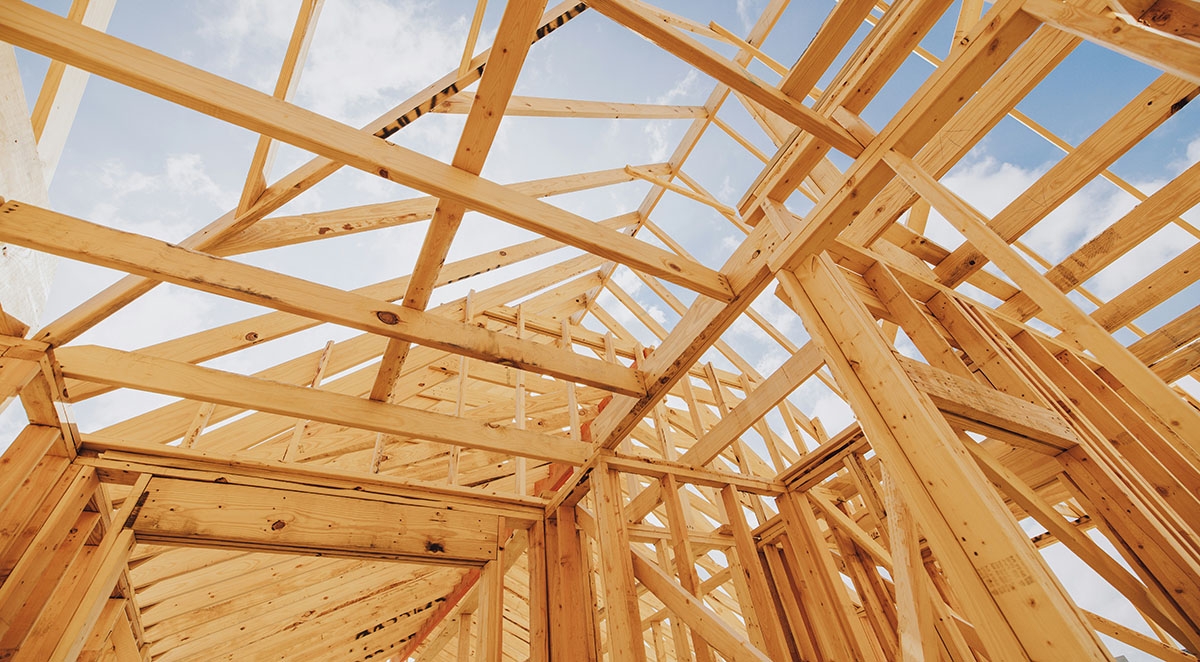
As mentioned before, some of the heavier-duty cuts are used for trusses, rafters, and joists. Roof systems rely on very accurately measured lumber to provide structure and distribute the weight of roofing materials properly across the home. Rafters, trusses, and joists all depend on consistent dimensions to provide proper alignment and security during construction.
Planed lumber will almost always simplify the process by providing smooth, uniform surfaces during framing. This makes it way easier for contractors topositiona nd assemble individual components of a roof system. This is particularly useful for large projects where they may have some prefabricated assemblies or custom roof designs.
3. Flooring and Subflooring
Wood flooring is almost always made of carefully planed hardwoods, and in some cases pine. However, there is nothing quite like a beautifully planed oak floor. However, if lumber is properly cut and surfaced, that beautiful showcase flooring can look out of level really quickly.
Hardwood flooring needs smooth, consistent surfaces; otherwise the aesthetic will be lost in the off-camber, out of square wood. Flooring is the planer mill's bread and butter.
4. Interior Trim, Molding and Millwork
The further down this list we go, the more precise the processing must be. Trim, molding, and millwork are all finishing details that give a home a polished, refined appearance. If one thing is off, the whole home can appear to be improperly built. From baseboards and door casings to crown molding and decorative wall trim, these components rely on accurately processed lumber to achieve clean lines and consistent dimensions.
Planed lumber is particularly useful for finish carpentry because its smooth surfaces provide a suitable starting point for sanding, painting, staining, and additional machining. Consistent thickness and dimensions also make it easier for carpenters and millwork manufacturers to cut, shape, and install trim components.
5. Doors, Windows, and Cabinetry
While doors, windows, and cabinets are often manufactured offsite rather than built by contractors, manufacturers still need lumber that can be easily cut, joined, and assembled. Whether producing cabinet face frames, door components, window trim, or custom built-ins, consistent lumber dimensions help manufacturers maintain quality throughout the production process.
Planed lumber provides a smoother, more uniform surface that makes additional woodworking operations easier. Material can be further processed through ripping, chopping, shaping, and joinery operations to create components that fit specific manufacturing requirements.
Find Quality Planed Lumber for Your Next Construction Project
As we have shown, planed lumber is used in nearly every facet of home construction, including the manufacturing of cabinets and doors, installation of joists, and framing materials, and more. These are just a few of the ways a planer mill can support a home builder.
Church and Church Planer Mill is a great resource for builders, contractors, manufacturers, and homeowners seeking custom milled lumber. We have been providing home builders with high-quality planed lumber for four generations. Our timber buyers have access to a variety of species of wood across Appalachia. We source, cut, mill, kiln-dry, and deliver the best quality lumber to builders across North Carolina and beyond.
Whether you are building a new home, completing a renovation, or producing custom architectural woodwork, the right lumber can make a difference in the finished project. Church & Church Planer Mill provides custom milling capabilities and a variety of hardwood and pine products to meet different construction and manufacturing needs. Contact Church & Church to discuss your lumber requirements and learn more about our planer mill capabilities in Wilkes County, North Carolina.